








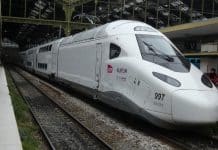




Cover photo. The TGV M during its presentation at Paris Gare de Lyon on July 31, 2023. Archive photograph. Resized without cropping. Rémi Simonnin / Wikimedia Commons / Adaptation licensed under CC BY-SA 4.0.

The TGV M has finally arrived. Renamed TGV Nouvelle Génération for its launch, it makes its inaugural journey between Paris and Marseille this Friday, November 6. Regular commercial services are due to follow on November 9, with Nice added at the end of the month. TourMaG, reporting from the inaugural journey, sets out that timetable. For travelers, that means an unusual few weeks ahead: the same destination and the same TGV INOUI brand, but trains of different ages with different interiors.
The changes offer more than something new for rail enthusiasts to admire. More legroom in second class, wider seats in first, extra luggage storage, eight spaces for bicycles carried fully assembled and a redesigned boarding system for wheelchair users could all improve a journey. We have not yet traveled on this new train. What interests us today is how those features can help us make a better choice when buying a ticket.
Someone traveling alone with a small bag, a family with a stroller and a cyclist will focus on different details. The solo traveler may be weighing up a more comfortable second class against a more expensive first-class ticket. The family will want to sit together and store their belongings without blocking the aisle. The cyclist will need a departure that actually accepts their bicycle. For all three, knowing which train will operate can matter as much as the departure time.
This is where SNCF still has work to do: helping customers understand what they are buying while several generations of trains run alongside one another. We know how to choose between a window seat and an aisle seat. Identifying a train with equipment that better meets our needs should be just as straightforward. That information also needs to be reliable enough to base a decision on.
We welcome this renewal. Small but useful improvements matter, too, such as an individual power outlet or better-placed storage. Over several hours, details like these make a difference to comfort. Even so, it is worth keeping a sense of proportion before paying more, changing departure times or complicating a connection simply to ride the latest model.
At launch, few departures will use the new TGV
SNCF Voyageurs says the first six trains will serve the Paris–Marseille route, initially with one daily round trip. The rollout will be gradual. The company also makes clear that this generation was not designed to travel faster. Its main appeal will therefore be inside: the space, the equipment and how passengers can spend their time on board.
That changes how to approach a search. Booking Paris–Marseille after November 9 will not, by itself, put you on the new TGV. Nor will booking a trip to Nice in the first few days of November. Check the specific departure, date and accompanying information, then seek confirmation of the train type if one of its features is essential to your trip.
A useful starting point is SNCF Connect’s train-number search, which provides information including the train’s composition and onboard services. That is more helpful than looking for a photograph of the route. You still need to check whether the bicycle space or accessible seat you require is available.


Above all, we would avoid planning a trip around an assumption. A picture of the new train on a destination page, the INOUI name or an attractive presentation of the route may not describe the train on your chosen departure. While the rollout remains limited, asking for confirmation before buying is sensible. For a wheelchair or a bicycle carried fully assembled, that check needs to cover the reservation itself and the services you will need.
A rail enthusiast may be happy to leave earlier or later to try the new train. For work, a family visit or the start of a vacation, the schedule should still come first. Arriving too late, adding another change or struggling to reach the station in time can quickly make a better seat seem less worthwhile.
The new TGV also needs to fit the rest of the journey. Someone arriving in Marseille and continuing by local transport should check the arrival time and onward route. Someone heading to a meeting gains little from a good tray table if the chosen schedule leaves too little time to get there. A good seat cannot make up for a poorly planned journey.
None of this takes away the pleasure of discovering a new train. It simply keeps novelty from becoming the deciding factor for every trip. With comparable journey times, schedules and fares, we would gladly choose the new generation. When those differ substantially, we would start with what matters most for the journey we need to make.
Second class becomes a more appealing choice
Second class deserves particular attention. TGV INOUI says there will be up to five extra centimeters of legroom, an adjustable headrest, a reading light and a power outlet at every seat. The words “up to” matter: they do not mean every seat gains the same amount of space. For travelers who usually feel short of space, this is an improvement worth examining.
For someone spending several hours with a laptop, or needing room to change position, a few centimeters can be more useful than another screen. Small changes can give knees a little more room, make it easier to open a laptop and provide somewhere handy for a phone. A modern train should make those ordinary tasks easier.
In our August 2024 second-class journey from Nancy to Paris, we described a fairly basic trip on a refurbished TGV Réseau. Legroom was limited and the shared armrest was awkward when both neighbors were working. That was one particular journey on a different type of train. It nevertheless shows why the INOUI name alone is not enough to tell us how comfortable a seat will be.
Better-equipped second class makes the comparison with first class more interesting. Someone who usually upgrades to work for a few hours may be able to reconsider. Someone seeking a single seat, more width or a little more distance from a neighbor will have other reasons to pay extra. These travelers are looking for different things.
Whether the extra cost is worthwhile therefore depends on what you need from a seat. Good second class can be perfectly adequate for reading, sleeping for a while or watching a movie. For work that needs more space, or a long journey where personal space matters, the first-class premium may be justified. Habit should not be the only explanation for paying it.
The people and activity around the seat matter, too. Facing seats can be pleasant for a conversation among four people, but less suitable for someone who wants to stretch out without getting in anyone’s way. A seat near a busy passage makes moving around easier but brings more people passing by. Even on a new train, the right seat depends on the traveler.
In first class, look at what the extra money buys
In first class, SNCF Voyageurs says seats will be five centimeters wider and recline further. This is an increase in seat width, distinct from the extra legroom announced for second class. For travelers who feel cramped, it is a change worth considering, particularly on a long trip.


First class should not, however, be confused with the complete range of services aimed at business travelers. SNCF offers several different products. Access to the OPTIMUM area is restricted to passengers holding an eligible ticket. Booking first class should therefore not be taken to include every area or service featured on the sales pages.
Before paying, read what comes with the fare: change and cancellation conditions, included services and the seat offered. Those features can matter far more than a slightly wider seat if the time of your return is uncertain. A business trip does not always end when expected.
For a vacation with fixed dates, on the other hand, the flexibility of a more expensive fare may offer little value. The extra money can go toward comfort instead, provided the difference is acceptable. Whether first class is worth it depends on the price and what you need from it.
In our August 2024 first-class trip from Paris to Nancy, we described the long walk to the car on a service formed of two coupled trains, and the lack of service at our seats. The journey was still decent. A first-class ticket did not remove the walk along the platform or the need to visit the bar. Again, that was a different train on a different route. The booking lesson remains useful: checking what is actually included avoids misplaced expectations.
Once the new trains are in service, we will also judge how they hold up. A seat can look inviting in a photograph but need a long journey to reveal its strengths or weaknesses. Maintenance, cleanliness and working equipment will matter just as much after several months. For now, the announced features make us want to try it; they do not replace a firsthand journey report.
More storage does not mean a larger luggage allowance
Storage is one of the improvements we are most looking forward to. TGV INOUI says the train will offer up to 20% more luggage space per passenger. That can make a train more pleasant without radically changing the seat: a clear aisle and somewhere near your seat to put a suitcase improve the trip, too.
The layout and the rules are separate matters. The current TGV INOUI luggage policy allows each person two bags measuring no more than 70 × 90 × 50 cm and one smaller bag of up to 40 × 30 × 15 cm. Bags must be labeled. Passengers must be able to carry their belongings themselves in one trip and store them without blocking passageways. SNCF has not announced a larger luggage allowance for the new train.
For one person with a reasonably sized suitcase, this takes little preparation. For a family, the combined load soon becomes more complicated: several bags, coats, perhaps a stroller and the things needed during the journey. It helps to decide what must stay within reach and what can be put away for several hours.


One small shared bag is useful for things needed on the way: water, food, children’s supplies and necessary medication. That is easier than opening several suitcases in the aisle. The preparation seems unremarkable until someone needs a piece of clothing from the bottom of a bag while other passengers are trying to reach their seats.
Adults should also divide the tasks before boarding. Who stays with the child? Who carries the folded stroller? Who takes the large suitcases? More generous storage helps once everyone is aboard. It does not remove the need to get through the door, find the right car and move your belongings without repeated trips back and forth.
The choice of deck can then matter more than the view. Carrying a heavy suitcase upstairs for the scenery may be a poor trade-off if it has to be brought down again quickly. Before automatically choosing the upper deck, check how to reach the seats offered. If mobility or carrying luggage is difficult, that question needs to be settled when booking.
Proper storage helps everyone. A properly stored suitcase lets another passenger pass, gives staff room to move and makes getting off easier. The new train will have succeeded if storage is easier when every seat is occupied. A busy departure, with ordinary travelers and their belongings, will show what the extra space really delivers.
Taking a bicycle? Book the whole journey first
The eight spaces for fully assembled bicycles are a useful addition. They are spread across three areas. This makes the new TGV particularly appealing for a cycling vacation, when dismantling and packing a bicycle can complicate the trip before you even reach the station.
Bicycle spaces remain limited. If several people are traveling together with bicycles, include the bikes from the moment you start searching for tickets. Buying passenger tickets first and sorting out the bicycles later is the wrong order: you can have a seat on a train with no remaining room for your bike.
The conditions published by SNCF Voyageurs require the bicycle space to be reserved at the same time as the passenger ticket. It currently costs €10 per bicycle per journey on TGV INOUI. A search returning no results can mean that a train does not accept fully assembled bicycles or that its bicycle spaces are already taken. It does not establish that every passenger seat has been sold. A folded bicycle measuring no more than 90 × 130 × 50 cm can travel free as luggage. A dismantled bicycle must be fully enclosed in a labeled cover within the same size limit. Neither option requires a dedicated bicycle reservation. The allowance for other luggage varies with how the bicycle is carried, so check the rules for your particular arrangement.
For a journey with a connection, check every train before confirming the booking. The first leg may be ideal and the next much less straightforward. Time to get off with a bicycle, reach another platform and board again also needs to influence the choice. A connection that is comfortable with a small bag can be very tight with a loaded bike.
The journey of anyone accompanying the cyclist needs attention, too. SNCF currently requires separate bookings for cyclists and non-cyclists traveling on the same departure. That means taking extra care to select the same train and seats as close together as possible. The advertised number of spaces does not solve every booking difficulty.


We would still rather have eight well-designed spaces than need to dismantle a bicycle every time. The benefit can be decisive for someone going on a cycling trip. Precisely because this equipment is useful, it needs to be easy to reserve. Carrying a bicycle by train is only helpful if the whole trip, including the return, can be arranged without discovering a problem after paying.
Accessibility deserves more than a photograph of an open door
The new generation also brings an important change for wheelchair users. SNCF presents an accessible car, a built-in lift and a device that bridges the gap between platform and train to make independent boarding easier. It says the train will have up to five wheelchair spaces and larger restrooms, with room to turn and for someone to assist.
We consider this a more important development than a redesigned seat. Boarding a train with less reliance on outside help directly affects the freedom to travel. It can make departure easier, reduce anxiety before a trip and make traveling by train a more straightforward choice.
The entire route still needs preparation. A better-equipped car alone tells us nothing about the elevator at a connecting station, the route between platforms or access at the destination station. The new equipment can make boarding easier without removing the need for assistance in stations or during connections.
The current SNCF assistance conditions provide a free service for eligible passengers. To guarantee assistance, it must be booked no later than 24 hours before departure, and passengers must arrive at the meeting point 30 minutes before departure. Assistance without a reservation is not guaranteed. The announcement of more independent boarding is therefore no reason to cancel help still needed elsewhere on the journey.
We would also check the return arrangements and what happens if the train changes. When a journey depends on an accessible space and booked assistance, changing departure times means checking those elements together. A flexible ticket alone does not establish whether the new itinerary will meet the same needs.
It would be a shame to reduce the issue to an “accessible” box on a list of features. Using the restroom, finding your way around and buying something to eat are all part of the journey. The new TGV includes delivery to the seat for wheelchair users traveling alone who cannot reach the Bistro. That is the kind of practical detail we expect when a train is designed around the people using it.
The promised independence will be progress if it remains a choice for passengers. Those who want assistance should be able to request it; those able to travel more freely should be able to do so. The new trains should allow more people to move around on board independently. The rest of the journey needs to let them benefit from that freedom.
A more welcoming Bistro, shared by everyone on board
The new Bistro occupies two levels: a sales area downstairs and a room with 28 seats upstairs. The appeal is easy to understand: leave your seat, eat somewhere other than a small tray table and enjoy the scenery for a while in a space designed for it. On a long trip, that could make the hours on board less monotonous.


Remember that this room will be shared by all passengers who want to use it. We would not plan a work meeting or a large group’s meal on the assumption that seats will be free at a specific time. A family should retain the option of eating at its own seats if the Bistro is busy.
The idea sounds more welcoming than a simple counter where passengers buy something before returning to their seats. A train gives us time to read, look outside or talk. Somewhere to stop for a while offers a little more freedom during the trip. We still need to see how busy it becomes and how people move between the two levels when the train is full.
For the meal itself, we would keep an easy alternative if timing matters, particularly with a child. Choosing the new train guarantees neither a seat in the Bistro at the right time nor the availability of everything everyone wants to eat. If a meal cannot wait, plan to have something you can eat at your seat.
The same thinking applies to work. Individual power outlets are useful when both neighbors need to charge their devices. The table and storage can save the constant reshuffling of phone, cup and laptop. A train remains a shared space, however: even with a good connection, a video meeting should not disturb the whole car.
TGV INOUI says Wi-Fi will be better. We will wait for regular use before judging its reliability. For a document that absolutely has to be finished, we would still download the files before leaving and keep a way to work offline. That is a simple precaution when a deadline matters, rather than a particular criticism of the new train.
The real comfort of a business trip may come from not scheduling anything too demanding on board. Reading a document, writing or preparing for a meeting can work well on a train. Back-to-back calls requiring hours of talking are more likely to disturb the people nearby. A comfortable new train does not remove the need to be considerate.
Traveling as a family: start with the seats and schedule
A new train can make it tempting to take the children along to discover it. For a family trip, however, we would still start with a simple question: can we sit comfortably together? A good seating arrangement and a departure time that fits the day will often offer more than a novelty the children may soon lose interest in.
SNCF offers groups of four seats facing one another in both classes. In second class, the Espace Famille is a free option at certain times: weekends from Friday afternoon, school vacations and public holidays. Check what is actually offered on the chosen departure and select the option when buying the tickets.


Facing seats make a shared game or meal easier. They can also leave less room when everyone’s legs meet under the same table. For four adults, or tall teenagers, we would examine that layout just as carefully as for a family with small children. A table for four can suit one journey and be less comfortable on another, depending on the passengers’ height and what they want to do on board.
If the seats you want are no longer available, shifting departure times slightly can be worthwhile. That is a better reason to change departure times than simply wanting to ride the new TGV. If the preceding train lets everyone sit together and arrives at a more convenient time, it may be the better choice, even with an older interior.
When several people travel together, compare the total price as well. A small supplement per person becomes a significant amount for a whole family. That does not make first class unjustifiable; it makes understanding what it adds more important. If the main aim is to sit together, put the bags away and eat together, start by checking those possibilities in second class.
Those concerns may seem down-to-earth alongside the unveiling of a new showcase for rail engineering. It is nevertheless how a train becomes useful in travelers’ lives. With children, the priority is usually to arrive in good shape, without having spent the journey finding somewhere for the bags or splitting the family between several cars.
More capacity does not promise cheaper tickets
The figure of 740 seats appears frequently in coverage of the TGV M. That is the maximum capacity made possible by the modular design. At launch, L’Écho touristique reports a 573-seat configuration. It would therefore be wrong to assume that every new TGV will immediately have 740 seats or the same layout.
SNCF explains that the train’s configuration and interior spaces can change to meet different needs. That benefits the operator, which can adapt its trains. Passengers will benefit if this flexibility brings the seats and equipment they need to departures where those are lacking. The outcome will depend on the choices made for each route.
We should also resist assuming that more capacity means lower prices. L’Écho touristique reports Jean Castex saying that the new train will not, in itself, raise or lower fares. That is a statement by SNCF, rather than a guarantee about the price of a particular departure.


When buying, we would compare the offers actually available at the time of the search. Differences between departure times, change conditions and the cost of the whole journey remain the things to examine. A better-designed train may be worth a small premium to some travelers. It may also be less appealing than an older train with a better schedule and a lower fare.
The benefits of the new trains also need to be judged over several years. Not every benefit will appear in the price of the following Monday’s ticket. Trains offering more seats, using less energy and adapting better to the needs of different routes can improve service over time. It is reasonable for SNCF to think about maintenance, fleet use and costs as well.
Our reservation concerns how those benefits are explained to customers. The operator’s savings, the maximum capacity of one version and the comfort of a reserved seat are different things. Each matters in its own way. To choose a ticket, we mainly need to know which train we will travel on, where we will sit and what the fare includes.
Choose the improvements for the right reasons
The arrival of the TGV Nouvelle Génération is good news. There is something rather pleasing about seeing a train evolve around needs as ordinary as putting down a laptop, storing a suitcase or boarding with a bicycle. Rail comfort depends heavily on these details, repeated over several hours and many journeys.
We would focus on three reasons to seek out the new trains: a layout that better meets a particular need, a suitable departure time and an acceptable price. For someone taking a fully assembled bicycle, needing an accessible space or wanting more room in second class, the new train could change which departure they choose. For someone whose main concern is arriving on time, it will remain one consideration among others.
SNCF should not stop at presenting the train. During the rollout, the information provided at booking will be decisive. The more a feature matters to a passenger, the less they should have to guess whether it is present from a brand name or a photograph. The new features will be truly useful when choosing them is as easy as choosing a departure time.
We now want to see how the train performs on ordinary journeys: busy departures, people with their belongings, workdays and returns from vacation. The inaugural journey showcases the engineering. The coming months will show how the train fits into travel habits and whether it keeps its promises over time.
We want to try it. The schedule, seats, luggage, any bicycle, assistance needs and fare conditions still come first. We will choose a departure that suits our trip, rather than rearranging the whole journey just to try a new train. Then we can judge what this new generation really adds.
Sources
TourMaG, Céline Eymery, “SNCF: Marseille, Nice, the Alps… the TGV M is finally on its way”, November 6, 2026.
L’Écho touristique, Linda Lainé, “TGV M: first journey to Marseille, Nice from late November”, November 6, 2026.
SNCF Voyageurs, TGV Nouvelle Génération presentation, updated November 1, 2026.
TGV INOUI, TGV Nouvelle Génération equipment and features, accessed November 6, 2026.
Groupe SNCF, “Welcome to the TGV Nouvelle Génération”, updated November 5, 2026.
SNCF Voyageurs, luggage rules, updated September 30, 2026.
SNCF Voyageurs, bicycle carriage conditions, updated September 30, 2026.
SNCF Voyageurs, assistance service conditions, updated September 3, 2026.
SNCF Connect, train information search by number, accessed November 6, 2026.
SNCF Voyageurs, onboard services, updated October 12, 2026.
Historical and generic photographs are labeled as illustrations. They are not a report from aboard the TGV Nouvelle Génération.
